Thursday, 19 January 2017

More tanks!

It has been worrying me for a while that I haven't posted anything here. This has really been because I've had my mind on other things and not on those involved in wargaming.

Anyway, now we are in 2017, I need to start painting again so I can take part in the TooFatLardies painting challenge run by Robert Avery on his excellent Vis Lardica website.

I've had three boxes of PSC 15mm tanks sitting around for ages and, while stuck in the house with a chest infection decided to make these up and paint them. The results are below. These will be added to my IABSM forces.

First off are some American tanks (I've also got a load of PSC US infantry and heavy weapons to do). Here are five M4A2 75mm models;


 And here are some M5A1 37mm light tanks. There are different variants but will all play a role as Panzer cannon fodder a scout platoon for the Americans in Normandy and beyond.


 Now we come to the big cats, Panthers to be precise. These will be a lethal addition to my already formidable array of German armour.


I decided to festoon these with vegetation so as to better disguise them in the Norman bocage. I'd previously done the same last year with some Stug III assault guns, shown below;


So, I am finally back painting and I have a new project in the offing, which I will write about in a separate post later.

Monday, 21 November 2016

American Civil War artillery

I bought these figures ages ago but didn't do anything with them until recently. Even so, they ended up undercoated for a while before I finally got round to painting them. Anyway, now they are done.

They are, as usual Peter Pig 15mm figures and are for my Sharp Practice forces. Both the Federals and the Rebels have a single cannon and limber, with a crew of five gunners plus a Leader.


Sunday, 30 October 2016

Some Syldavian and Bordurian buildings

These rather nice models are 15mm resin one from Hovels. They are from their Eastern Europe range.

First, there is a small church;


I did a bit of googling for images of churches in the Balkans and found lots of pictures of ones with green roofs. So, green it is.

Secondly, here is what Hovels describe as a "Regional Governors house" but which I think looks more like something owned by a well-off peasant farmer or maybe a local town burgomaster. I decided that some colour was what was required here to make this building stand out;


I wrote in a previous piece about Sir William Huntley-Palmer, "Sir William also writes of the customs and superstitions of the peasants of the southern marches of the province of Moltuja. He writes at length of the legend of a fearsome demonic sorcerer from the icy north known as Crna Tomascz or Black Thomas, who the peasants believe has the power to reanimate the recently-deceased and enslave them for his evil purposes. Sir William writes that  the peasants of this region, being superstitious and in much fear of  Crna Tomascz paint their window and door frames with blue paint, which they believe will ward off the demon. He records that “the people believe that Crna Tomascz knows when someone is close to death and will climb into the house and bewitch them so that once buried he can call forth the corpse from the grave”. He also writes that across the whole region many rural buildings have their roofs partially painted red, especially along the ridges and hips to prevent a demonic entity, which he says the peasants call a  “Noc Vitek”  (trans. Night Gaunt) from roosting there."

Seeing as there isn't really a great deal of difference between the people who inhabit Syldavia and Borduria, these buildings should work happily for both sides and will look good on the table.

Thursday, 27 October 2016

More about Sir William Huntley-Palmer

Excerpts from the never-published memoir “Journeying in Syldavia” by Sir William Huntley-Palmer, which is an account of the author’s time spent in the service of King Ottokar IX of that country.

“In the Spring of 1756, I found myself once more in Klow, the capital city of the Kingdom of Syldavia. I had found accommodation in an apartment in an old Klovene tower house in the mediaeval quarter of the city, the area being often referred to as Klovinus, which was the name of the original Roman city, not far from the ancient Cathedral or Basilica of St Budvar (occasionally but incorrectly referred to as St Vladimir). My landlord, Freiherr Stefan von Stiflipz was a senior officer in an infantry regiment. He claimed descent from the ancient Slav tribe of the Hvegi and said that the house had been the residence of Sidekar Krutusne, a famous warlord of the Hvegs in the 15th century, and who was one of the first members of the Order of the Black Pelican. The Pelican was carved above the entrance to the house, bearing in its beak a scroll emblazoned with the Latin phrase “hoc signo vinces nigrum onocrotalus”.

Von Stiflipz was a genial fellow, and we often shared a bottle or two of the excellent local wine over dinner of an evening, generally conversing in either German or, when my grasp of that language failed, in French, a tongue that was becoming widely spoken by the educated classes of the country. We discussed the history of Syldavia, with Von Stiflipz expounding at great length on the important role of the Hvegi tribes in the unification of the country and how Muscarius Hivegiorum (Muskar Hveghi or Muskar of the Hvegs) defeated the Turkic Khan of Istrovia (Roman Syldavia Inferior) and became King Muskar I.

A fairly frequent guest was Hauptmann Wilhelm Tischdecke, a young Captain of Jägers, previously serving in a Pandour regiment who had recently arranged a commission in the more fashionable Strelec Regiment of Jägers. There was much talk of sending troops to the south where there had recently been Ottoman incursions in the province of Zeta, to the north of Lake Skhoder, threatening both the provincial capital, Cetinjow and the important market town of Bjelogoritza, further up the River Zeta, near the confluence with its tributary, the Jetinuja River.

I was keen to travel south with any expeditionary force and Von Stiflipz was able to introduce me to  Rittmeister (that is captain) Marko Tvrdoglav of the Grünerwald Dragoon regiment, which had been mobilised for service in the South. Because of my previous service in Kerr’s Dragoons, the Rittmeister was happy to arrange permission for me to accompany his squadron as far as Cetinjow.

Within the month a small vanguard had been formed and sent south. This comprised two squadrons of the  Grünerwald Dragoons, one from the Eszakivaros Huzzars and an impromptu brigade formed from five companies of foot from the Motörkopf regiment, three companies of Lasko’s Pandours and Hauptmann Tischdecke’s  Jäger company.  I rode with Rittmeister Tvrdoglav’s Dragoons, accompanied by my manservant Domenico, a Venetian who claimed to be the illegitimate son of a member of the Morosini family. The remaining  troops would follow on within a few weeks, some by the same route that we had taken along the valley of the River Wladir, but others by sea, south along the coast from Dbrnouk to Rudva, a port to the southwest of Cetinjow. In total, the army was expected to consist of six battalions of Foot, three of Pandours, a dozen squadrons of various types of Horse and a number of troops of Artillery.”

Sir William writes at length of the landscape through which the small force passes. He complains that he was unable to visit the city of Istow (formerly Istrow, Roman Istriodunum) to view the Roman ruins but vows to return at a future date. (n.b. Huntley-Palmer visited Istow in 1759 and commissioned the painting “The Ruins of Istriodunum by Moonlight” which now hangs in the Staatliches Kunstmuseum ( Državni muzej umjetnosti) in Klow.

Sir William also writes of the customs and superstitions of the peasants of the southern marches of the province of Moltuja. He writes at length of the legend of a fearsome demonic sorcerer from the icy north known as Crna Tomascz or Black Thomas, who the peasants believe has the power to reanimate the recently-deceased and enslave them for his evil purposes. Sir William writes that  the peasants of this region, being superstitious and in much fear of  Crna Tomascz paint their window and door frames with blue paint, which they believe will ward off the demon. He records that “the people believe that Crna Tomascz knows when someone is close to death and will climb into the house and bewitch them so that once buried he can call forth the corpse from the grave”. He also writes that across the whole region many rural buildings have their roofs partially painted red, especially along the ridges and hips to prevent a demonic entity, which he says the peasants call a  “Noc Vitek”  (trans. Night Gaunt) from roosting there.

By the early Summer of 1756, H-P arrives in Cetinjow, which he describes as being “a city built on two hills, of  an antique appearance, dominated by a mediaeval citadel and encircled by walls of considerable height but which are in need of some repair. There are many fine buildings of some antiquity and numerous churches for followers of both the Latin and Greek Rites. There are also religious buildings for both Jews and Mussulmen and the city has a population in which one might discern divers peoples from the shores of the Mediterranean and the Levant, as well as the sturdy peasantry of Syldavia. On the streets one might hear the Venetian dialect one moment, followed by Greek, Magyar, Arabic, Turkish, the Syldavian Slavic tongue or the barbarous dialects of the mountains.

However, the troops are not to remain in the city for long and are soon on the move again, with the town of Bjelogoritza their final destination. While in Cetinjow, though, Sir William takes the opportunity to draw a detailed plan of the city and lists the major buildings, the state of the fortifications and the size and quality of the garrison. He records that “although the walls are tall and built of dressed stone, they are of such an age that they could not long withstand modern artillery, allowing a Forlorn Hope of steady troops to enter via the breach.” 

He is also scathing about the quality of the garrison of the city. He writes that “the city is garrisoned with two or three hundred militia men, who are slovenly and of poor quality, many appearing infirm. Their uniforms are of brown homespun of an old-fashioned cut and contrast poorly with the smart grey uniforms of the Motorköpf regiment and Captain Tischdecke‘s green-coated Jägers. There are also some locally-recruited Pandours of a barbarous and brigandlike appearance, who I believe are the sworn tribal enemies of  those of the Lasko Regiment who form part of our small brigade. Our Pandours are stout fellows, well-turned out and of an impressively warlike bearing but these others lack discipline, are prone to drunkenness, quarrel constantly and steal from the townspeople. I am sure that if the Turk had arrived before us, his Janissaries and Bashi-Bazooks would already be putting their feet up on the governor‘s dining table. There are no Horse at all, save for a few dozen of the Governor’s Gendarmerie, who are more suited to collecting Excise Monies than fighting and the only guns in the city’s bastions must have first seen service in the German Wars a century ago.

Thursday, 20 October 2016

Back to painting after a long break

Well, it's been a fair old while but I have started painting again for my Sharp Practice projects. I've done some civilians for my ACW setting and a few wagons and other stuff for Syldavia and Borduria.

Fiest, here are some civilians for the ACW. These will come in handy for various scenarios. They are Peter Pig 15mm.


I think that the woman on the right with the shotgun and the rather flighty-looking woman next to her will be very useful.

In the next two pictures, all the minis are from Magister Militum. First, I have painted up an Engineering group that can be used for either side because they have removed their uniform coats, no doubt due to the heat. An Engineering Group in Sharp Practice should have six figures, but I've done seven because that is how they come from Magister Militum.


The third set of figures represent the supply trains of the armies. I have a water wagon that can be used for either side and two ammunition wagons; yellow for Syldavia and green for Borduria. I've also got two small mule trains that can be used for resupply, or as an objective in a scenario.

None of the figures are in military dress. I've assumed that they are either civilian contractors or local peasants pressed into service.


Friday, 16 September 2016

Aliens!

As I wrote in my background piece about my imagined star system, in addition to the various Human factions there are also alien (xeno) species who inhabit the system. 

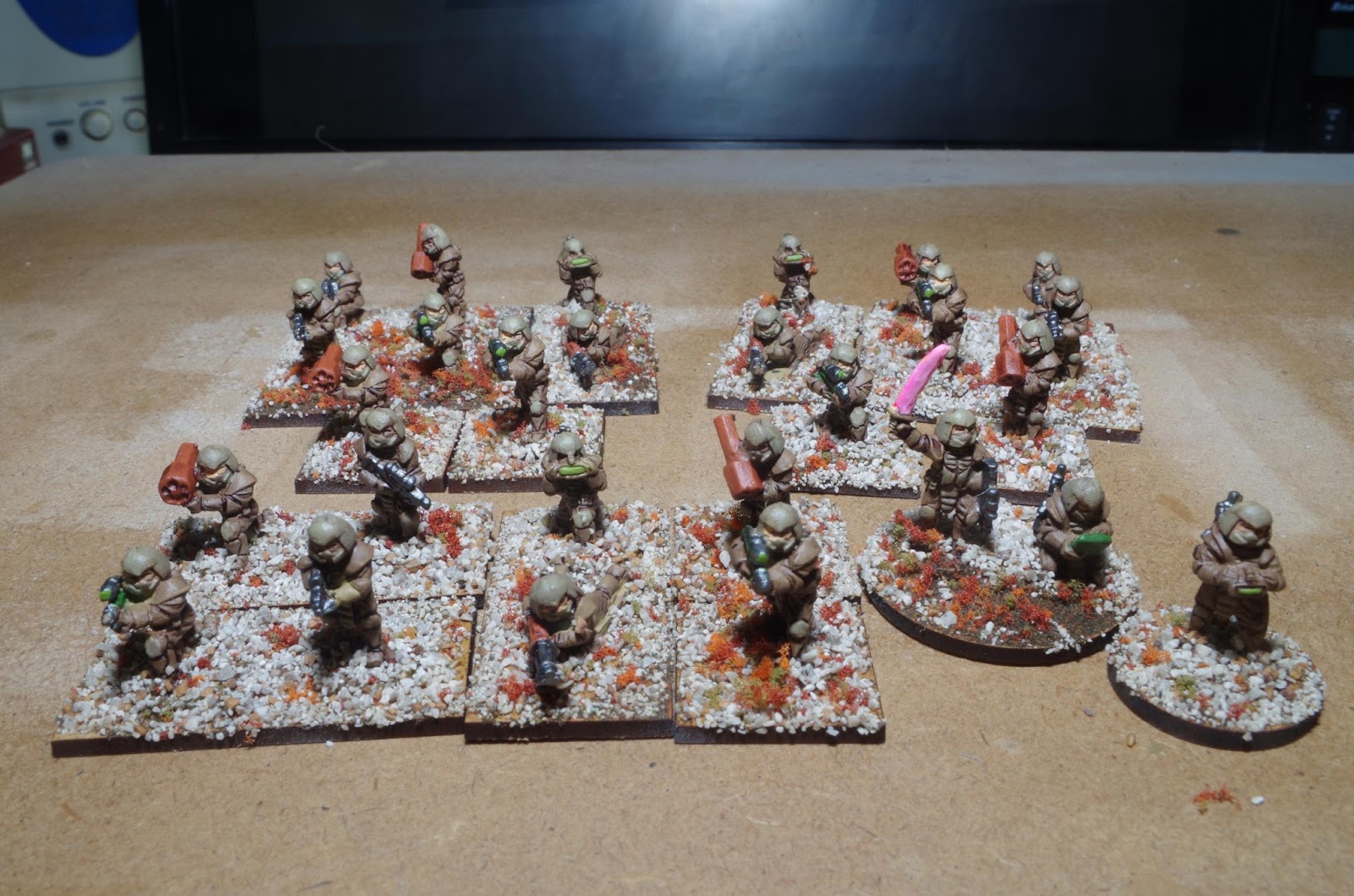
One faction is the aggressive and militaristic H'Rin Brood Family of the Glorious Kra'Vak Dominate. These are represented by the excellent GZG Kra'vak figures and vehicles. 

As I wrote previously, the Kra'vak are a planetary-based species, living on many worlds spread across a number of systems but there are also roving fleets of Kra'vak clans who are constantly seeking out new systems to conquer. The H'Rin Brood Family are one of these armadas of freebooting spacefarers. Their forces are mobile and fast-moving, as befitting aggressive raiders. The H'Rin raiding parties generally contain three types of troops. These are known to the Humans as hastati, principes and triarii, organised into maniples of between 20 and 30 individuals. The hastati are younger Kra'vak who act as scouts, the principes are older veterans who fight as the main strike force and the triarii are heavily-armed elite troops who act as a reserve or as assault troops. Each raiding party will contain all three types, grouped into a cohort, which might be supported by auxilia, who can be from any number of allied species or who might be contracted mercenaries or even pirates and outlaws.

So here are the three basic types of H'Rin Kra'vak troops. First, two maniples or platoons of hastati scouts. Each platoon consists of two squads of 10 troopers with energy rifles and 2 heavy energy weapons, with a commander and a section of 4 troopers with support weapons and a section leader/FOO.


Next, the main strike force of principes, comprising experienced fighters. Each platoon (maniple) consists of two infantry squads of 10 troopers (8 with standard energy rifles and 2 with the heavier support versions), plus a support squad of 8, equipped with 4 rocket launchers and 4 sniper energy rifles.


Finally, there is a single maniple of 15 triarii, elite veterans in heavier armour and completely equipped with the powerful assault energy rifles.


 This unit is accompanied by the overall cohort leader.

I have also painted up a couple of anti-grav vehicles for this raiding party, a command and ECM vehicle and a powerful tank.


 Finally, I have painted up two units of auxiliaries to add some variety. First is a platoon of Xar Bug warriors. I really like these. They are suitably alien-looking and are equipped with a variety of projectile and energy weapons.


Last, but not least I have a unit of what I can only describe as most definitely being Not-Space Orks, not least because they are red. These are all GZG Alien Mercenaries with the exception of the two bike riders, who are from The Scene, where they are described as Wasteland Warriors. In my imaginary future, these are members of a race called the Orak, pirates, outlaws and mercenaries.


Thursday, 1 September 2016

More Sci Fi warriors

Here are some more of my GZG 15mm Q13 minis. These are Japanese Corporate Ashigaru troops who I am using to represent the forces of the Tansa Guild in my invented universe.

First, here is a company of infantry, consisting of three platoons and the company HQ.


Note that the third platoon has more portable missile launchers than the other two in each eight-man squad. This is designated as the  anti-vehicle platoon.

Next, here are the heavy troops in power armour. There are four squads, each with six troopers, two with heavy weapons.


Next is a squad of tripod-mounted autocannons, to provide some fire support. These have two hover APCs as transports. These aren't from GZG. I bought these vehicles from a stand at a show and modified them with some spare turrets.


Next, here are the dreaded Tech Ninja infiltration specialists, armed with power swords and laser pistols or projectile hand weapons. I've designed these to operate as squads of four. They are close combat experts and they are equipped with cloaking technology to help them in their missions.


Finally, there is a platoon of drones, with a drone operator. These are the recce element of the force.