Showing posts with label hussars. Show all posts

Monday, 7 October 2019

The encounter at the ford - 18th century imagi-nations Sharp Practice

This is a Sharp Practice game played out at the club yesterday between myself commanding the Syldavians and Martin taking the role of the Bordurian commander, using my 15mm Essex armies. 

I have decided to write this up as an excerpt from the memoirs of Captain (later Sir) William Huntley-Palmer of the 11th Dragoons, as recorded in the Melchett Archives of General Sir George Augustus Melchett (a.k.a. "M"), a relative and patron of Capt. Huntley-Palmer.

"In the Summer of 1754, while on my travels in Syldavia representing the government of His Britannic Majesty King George II, I spent several weeks in the province of Moltuja, in the valley of the River Moltus, upstream from the town of Birna. This fertile region was often raided by Bordurian forces coming into Syldavia via the mountain pass just south of the headwaters of the Mecava Potak Reka. I was travelling with my host in Birna, the Edler Franz von Felstad and my servant Domenico, and we took the opportunity to join a small Syldavian force sent to secure a ford across the Moltus."

I set out the table to represent the river in an area with corn fields, trees and a small village where the ford, actually the site of a long-collapsed mediaeval bridge crossed the river. Both sets of troops consisted of five groups of line troops, one of skirmishing light infantry and one of scouting cavalry.

"The Edler von Felstad suggested that we should view the encounter from the summit of a hill to the west of the village, where we would have an excellent view of the proceedings. Von Felstad had personal reasons for watching the proceedings as his son, a Fähnrich, that is Ensign of Horse in the Vranac Huzzars was commanding the Syldavian cavalry. In addition, the Hauptmann or Captain commanding the company of Fusiliers, a Venetian emigré called Marcello Loredan was a neighbour of the Edler. We watched as the Syldavians began to advance upon the village, which was known as Koruna Kmetija in the local language. The first troops to advance were Jägers from the Strelec Regiment. In the distance we could also see white-coated Bordurians advancing. Von Felstad informed me that white coats were worn by the various Freikorps in the service of the Autokrat Constantine of Borduria, all of whom were known for their lack of moral probity and aggressive and plundering ways."


"Before long, the small company of Fusiliers from the famous Istow Regiment  began to advance, led by Hauptmann Loredan."


"As the battle unfolded, it became obvious that the Bordurians had seized the initiative, with their cavalry in position to charge any Syldavians who thought to cross the ford, which was also within the range of the muskets of the Freikorps and a company of Bordurian Jägers, whose skirmishers were equipped with rifles."


"Accurate musketry from across the river began to take its toll on the unfortunate green-coated Jägers, whose ranks were thinned as the balls hit home."


"However, the balance of power began to shift as Hauptman Loredan's fusiliers began to fire increasingly effective controlled volleys into the hated Bordurians across the river. I told the Edler that their control and accuracy was nearly as good as that of His Majesty King George's Foot Guards. Not really true, but my commission from General Melchett stressed that I should use praise and flattery wherever possible to gain the confidence of my Syldavian hosts."


"I noted with interest that the Bordurian Huzzars began to advance along the road towards the river. Surely they were not intending to cross into the hail of musketry?"


"I could only assume that their leader was a typical impulsive light cavalryman, such as those who fought with the Croats in the French service."
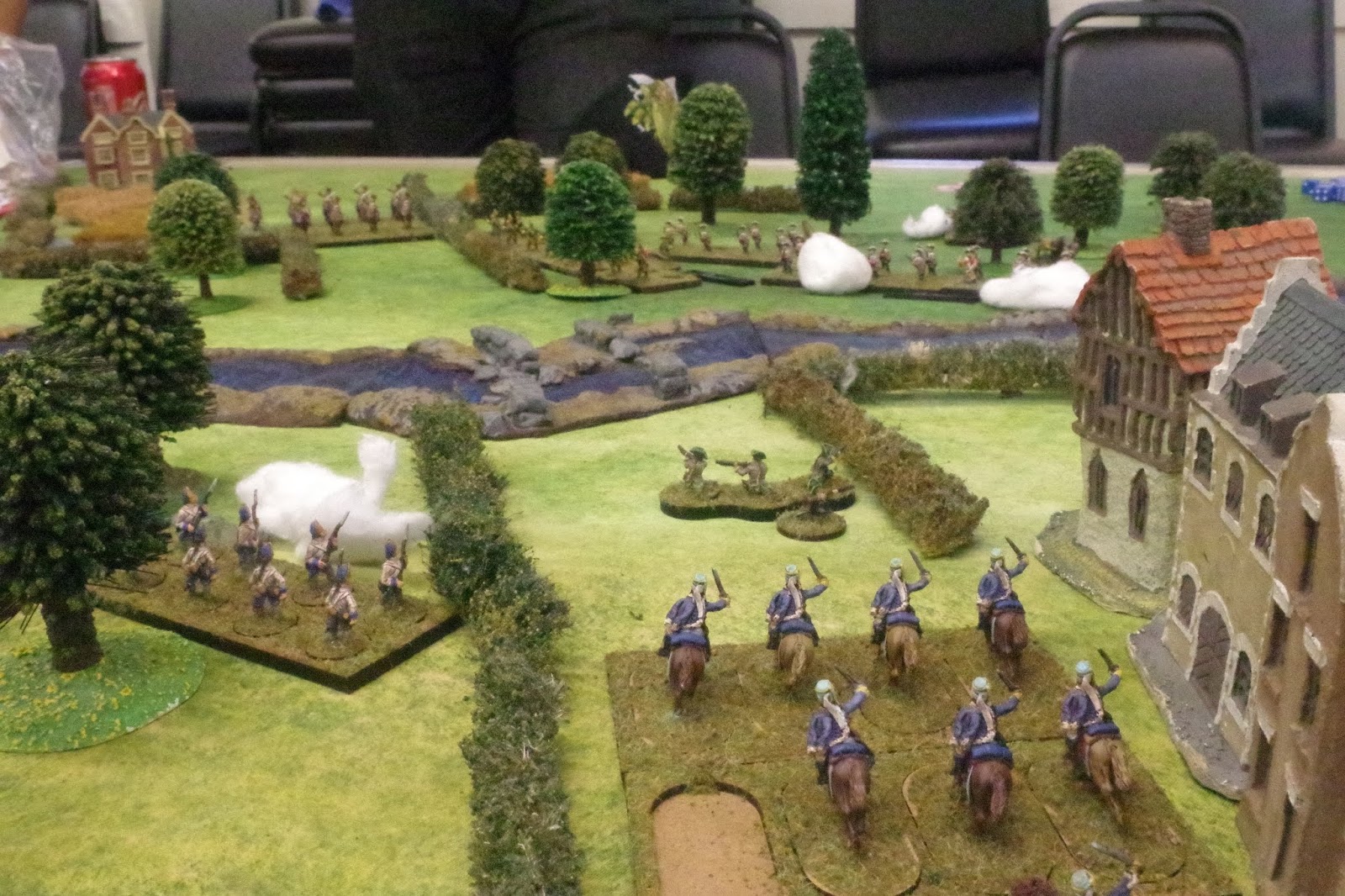

"I will admit that it was a stirring sight to see the Bordurian Huzzars, who I recognised as being from the well-known Freikorps Schtroumpf, gallop across the ford into contact with the Vranac Huzzars led by the young Fähnrich von Felstad. Initially pushing the grey-coated Syldavians back, the Schtroumpf Huzzars charged again, but were repulsed on the second attempt by the gallant Vranac troopers, who managed to kill the impetuous officer who had led his men to their doom. Musketry from short range from the Strelec Jägers lining the hedge took a further toll on the Freikorps riders who would take no further part in the proceedings."


"It seemed to me that the failure of the Bordurian cavalry, taken together with the weight of musket fire from the Istow Fusiliers was shifting the balance towards the gallant troops of my Syldavian hosts. Although both sides had suffered losses, the butcher's bill on the Bordurian side seemed to be rising at a faster rate. The Edler gripped my arm excitedly, says "My dear Captain Huntley-Palmer, I do believe that my son's intervention has swung the fight in our favour. I think that the Bordurians are obliged to withdraw." I murmured my agreement as I gazed across the field of honour. It did seem to me that the fusiliers of the white-coated Freikorps Schtroumpf were retreated through the woods, whence they had come only a short time ago. I offered my congratulations to the Edler and thanked him for the opportunity to see the Syldavian army in action. Privately, I thought that my next despatch to "M" would be of interest to Horse Guards, whose offices and clerks would apparently soon be housed in a new building**."


** The old Horse Guards building, which had become the administrative headquarters of the British Army was falling apart by the 1740s and a replacement building was commissioned in 1745. However, building works stretched out for about a decade after work first began in 1750.

Monday, 26 February 2018

Escort Duty - an Imagi-nations AAR for Sharp Practice.

I hadn't played any games with my Syldavians and Bordurians for quite some time, so yesterday's game at the club was a welcome opportunity to get them on the table again. The game we played was Scenario Four: Escort Duty.

The map is taken from the Sharp Practice rulebook.


All the figures are Essex 15mm.
 
Deployment points

Borduria enters the table at either Point 1 or 2, rolling to see which with an equal chance of either. They place a secondary Fixed Deployment point there, as they have no Primary Deployment Point for this scenario. Roll a further D6 and half that total, rounding up. The Bordurian player now takes that many moves with his entire force.
       
The Syldavian player now rolls a D6 to see which Deployment Point they use. On a roll of 1 to 4 they place their Primary Deployment Marker within 6” of that point. On a 5 or 6 they choose whichever Point they wish. Any secondary Deployment Points are placed and the game now begins.

Objective

To win, The Bordurians must exit the table on the far edge with the convoy they are escorting. The Syldavians must capture the convoy. 

I decided that this encounter would feature the Freikorps Schtroumpf, and would be an event from the early days of Frans Schtroumpf's career as a soldier of fortune in the service of Constantine II, Autokrator of Borduria. 

Before the start of the campaign against Syldavia in 1754, the Freikorps Schtroumpf was stationed in the border city of Oilcanya, to the west of the River Djrinje on the plains to the north of the Zympathian Mountains. Syldavian raiding parties had been crossing the river from the Syldavia city of Turksi Bazar and attacking Bordurian merchant caravans. The Freikorps was ordered to move south and provide escorts for caravans along the Djrinje valley. In early April, Pukovnik (colonel) Schtroumpf was personally accompanying an escort patrol because he had business in the small town of Bugrit, several kilometres inland from the border.


Forces

Syldavia

3 x groups of 8 x Fusiliers Status III leader Status I leader
2 x groups of 6 x Pandur Skirmishers Status II leader
1 x group of 8 x Hussars Status II leader
1 x group of 8 x Dragoons Status II leader
1 x Ammuntion cart

The Syldavian Fusiliers are classed as Regulars and the Dragoons are Impact Cavalry.

Borduria

3 x groups of 8 x Freikorps Fusiliers Status III leader (Frans Schtroumpf) Status I leader
2 x groups of 6 x Hajduk Skirmishers Status II leader
1 x group of 8 x Freikorps Hussars Status II leader
1 x cannon with 5 x crew and Status I leader
1 x Musician

The Freikorps Fusiliers are classed as Conscripts and Volunteers and have the Aggressive characteristic. The Hussars have a fearsome reputation and have the Blood Curdling characteristic. This means that when charging into Fisticuffs each group of opponents must roll 1D6 per figure. Each roll of 6 inflicts 1 point of shock on the group.

I played the Bordurians and the Syldavians were jointly handled by Andy and John

The table looked like this. The buildings, walls and fences are mine, the rest of the terrain belongs to the club. Here is the view from the Bordurian entry point end of the table;


A general view;


The view from the town of Bugrit. The Syldavians would enter the table from the left of the town.


The Bordurian convoy entered from the far right of the table as one complete entity and began to deploy along the road. The Hussars attempted to canter along the road to seize the entrance to the town, while the main body of infantry advanced to the right of the road, supported by the Hajduk skirmishers. The cannon moved round to the left of the farm. Already, Syldavian Pandur skirmishers were in the woods along the road and the unit of Dragoons from the De Bourbon regiment were attempting a flanking manoeuvre.


The Syldavian Vranac Hussars began a flanking advance to the left of the farm in front of the Bordurian troops.

The De Bourbon Dragoons charged against the Freikorps fusiliers, who were unloaded after firing at the Pandurs in the woods, but they failed to contact the enemy.


The Hajduk skirmishers to the right of the Fusiliers fired at the dragoons, causing casualties and shock. A random event roll inflicted "Charge them to Hell!" on the Hajduks and they hit the dragoons in the flank, inflicting more casualties and shock, forcing the dragoons to flee back towards their deployment point. Even worse, the dragoon leader was killed outright. Meanwhile the Vranac Hussars were threatening the Bordurian cannon, as well as the merchant caravan.

I swiftly moved some Hajduks and a group of Fusiliers to support the gun while it unlimbered. The resulting round of canister caused shock and casualties, forcing the Hussars to take refuge in the trees out of sight. The Syldavian cavalry were getting a bloody nose.


Things were not look that good for the Bordurian horse either, as the Freikorps Hussars also came under fire. The were forced to move out of the line of fire and regrouped away to the left near the town.


There is a shortage of pictures, but, after the Bordurian cavalry looped right round the outside of the farm, back towards their entry point the two groups of Hussars ended up in Fisticuffs, with the Syldavians coming off worse and breaking, fleeing from the field of honour. The loss of both cavalry units and their officers meant a big decline in Syldavian morale. Before long this would fall into the red band, which would cause them problems by losing Command Cards.


Elsewhere, the Istow regiment began to deploy, firing at long range on the Bordurians, causing some shock and a few casualties.


The Bordurians began to advance down the road, with the wagons and pack horses staying just behind the troops.


The Syldavian plan was to hold the line around the cornfield outside the town, preventing the wagon train to get past. The remaining Dragoons were finally rallied enough to rejoin the fight, but had to rely on the Force Commander to activate them.


The Bordurians, secure from flank attacks by the vanquished Syldavian Horse began to push ahead, first clearing the Pandur skirmishers from the woods and then engaging with the main Syldavian line. Skirmishers moved up to the farm and added their musketry to the battle. the gun would soon be ready to add fire to the battle.


Combat in this area would mean success or failure for Frans Schtroumpf's small force. Meanwhile, a single group of Freikorps fusiliers and the remaining Hussars made a flanking advance around the back of the farm. Eventually, these troops would arrive on the edge of town.
 

There was much combat along the road, with the Freikorps Fusiliers coming off best in shooting and fisticuffs against their opponents from the Syldavian Istow regiment, knocking their commander unconscious, forcing the Syldavians to break and capturing the ammunition wagon and the knocked out Syldavian officer. As the Schtroumpf Fusiliers prepared to charge the remaining Pandurs, the Pandur commander decided that discretion was the better part of valour and his troops evaded, withdrawing well away from the enemy. There was just one group of Syldavian infantry between the convoy and the town, with Bordurian Hussars and more fusiliers threatening them from across the road.


At this point, Syldavian morale had plummeted to 1 and they had lost all their remaining Command Cards, as well as their Force Commander. With heavy hearts, the battered remnants of the Syldavian raiding force decided to withdraw, realising that it was now almost impossible to prevent the merchant convoy from reaching Bugrit safely.

This was a terrific battle, and very bloody. It really could have gone either way but the loss of so many Leaders really hit the Syldavians hard, resulting in a hard-fought and costly victory for the Bordurians.