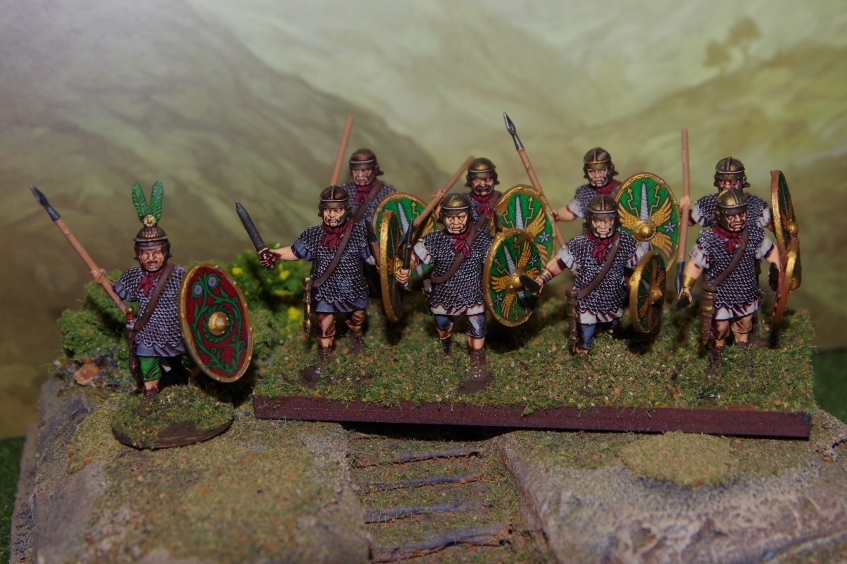
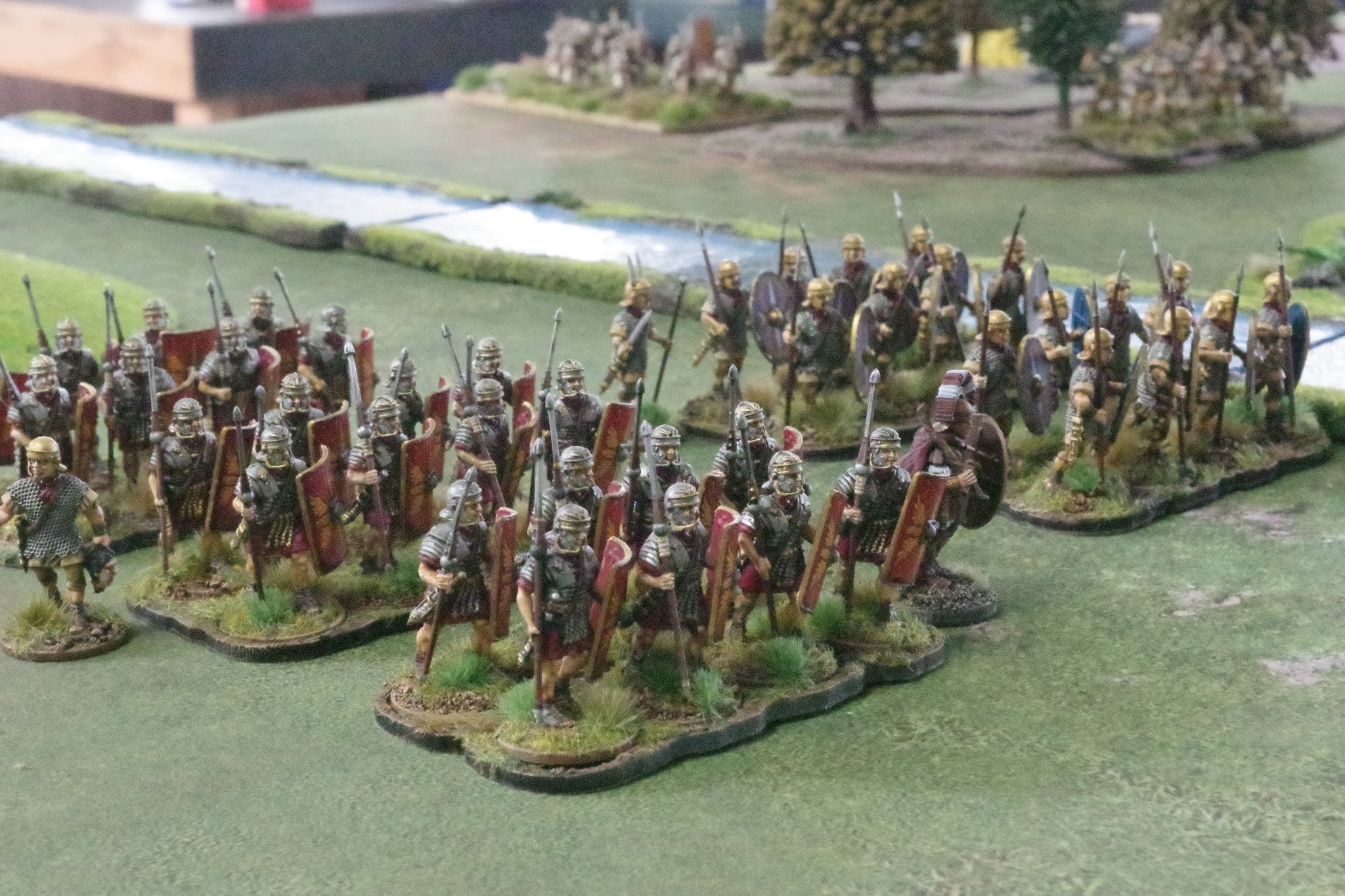
I have played around ten or so games of Infamy, Infamy, the TooFatLardies ancients skirmish rules to date, so I have had time to gather a few thoughts, although I cannot pretend to be in the position to really write a definitive review. All of the photos were taken at two days of (socially-distanced and Covid-safe) Infamy, Infamy games at BIG in Bristol recently. I shall intersperse my comments in between the pictures, but they won't necessarily relate to the images.
Now, I am a big fan of Lardie rules. I would say that Chain of Command and Sharp Practice are the two rulesets that I like more than anything else, from any rule publisher. Therefore, I was overjoyed when the news broke that Richard Clarke was working on rules for Ancients, specifically for Romans. It gave me a reason to buy the delightful Victrix plastic Romans that until now I'd never had a need to own.
I had a chance to play a couple of games at Crusade in Penarth back in January, before the plague descended upon the world, and I'd enjoyed the experience, but I wouldn't say that I really understood the rules, because I had found it hard to stop thinking about it as Sharp Practice with swords and spears. This, I have to stress is a big mistake. The rules are really very different.
I always wanted to build a Roman force. I wasn't interested in building a Gallic or Germanic force, and I am still not. Dacians, one of the subjects of a future rule supplement are a different matter. I like the Dacians a lot, but they are as yet an unknown quantity in Infamy, Infamy terms.
When it came to a force, I specifically wanted an auxiliary force. After all, those were the guys who did pretty much all the heavy lifting when it came to cross-border raids and punitive counter attacks. The legions were never stationed along the limes. They were held back for those situations when a larger force were required. To be honest, I don't see the legions as being the skirmishing types, certainly not in the Early to Middle Principate periods.
So, what do I think about the rules?
Well, to be honest, I think they are something of a Curate's Egg. There are definitely good things here, but equally, there are other aspects of the rules that I find problematic. I shall go into some of these later. My aim here is really to try and gather my thoughts in one place, and then go back in a few months once I have hopefully properly got to grips with the nuances and quirks.
As a Roman player, one thing I like is the way that to prosper, one has to play to the Roman strengths, things like formal drill and flexibility, two things which benefit the auxilia and which I suggest you really have to understand to have any chance of winning in scenarios set in bandit country. From my experience, winning in bandit country is very difficult indeed and I am not sure that it really reflects the historical record, something that I will return to below.

The legionaries are very tough cookies indeed. They are classed as having Heavy Armour, which gives them a 50% chance of surviving hits in combat, whereas the auxilia only have a one-in-three chance, being classed as having Medium Armour. To be honest, I personally think that this is historically incorrect. Early Imperial auxilia are pretty much wearing the same defensive kit as Late Republican legionaries, and also as many Imperial legions too, because we know that legionaries in reality weren't always equipped with the classic lorica segmentata (a modern coinage, we don't actually know what the Romans called their segmented cuirasses made of strips of metal). Legionaries also wore mail and scale armour, as can be seen on many surviving monuments, the Tropaeum Traiani being a prime example. Also, in pitched battles auxiliary cohorts fought alongside the legions, and were trained to fight in the same way as their citizen colleagues. We also have accounts of battles where the legions were held back as a reserve and the auxilia took the brunt of the action. Tacitus mentions this in his "Life of Agricola". However, I can understand why the rules would seek to make a distinction. Without a legionary/auxiliary difference the rules would lose some variety for the Roman player.

Auxiliaries are also distinguished by having flexible drill, which means that they can skirmish as well as fight as drilled troops in hand to hand combat. Inexplicably, perhaps, they are only allowed bows as ranged skirmish weapons, plus javelins, which are shorter ranged. There isn't an option for them to have slings, despite the huge number of Roman sling shot we find in archaeological digs. The only slingers allowed to the Early Imperial Romans are tribal ones. I see this as a shortcoming in the force rosters.

Now, on to cavalry. The Romans didn't really do effective cavalry. They did have citizen cavalry a long time before the period of the rules, that was the origin of the Equestrian Order, after all. However, by the period under discussion, cavalry were recruited from outside the citizenry, from the peregrini, the non-citizen inhabitants of the Empire or from allies. The cavalry were therefore part of the auxilia, mostly, and were of two types. They were either in specific cavalry units, known as Alae, and were clearly thought of as excellent troops because they were paid even more than the legionaries, or they were integral parts of mixed auxiliary units known as Cohortes Equitatae.
A Roman player can have either type of these cavalry in their force. However, and this seems odd to me, they do not count a being drilled troops. I do not understand why this is the case. We know that the Roman cavalry spent a lot of time training in complex movements and in fighting and other drills. The 2nd century author, historian and military commander Lucius Flavius Arrianus, better known as Arrian actually wrote a military drill manual, the Ars Tactica (Techne Taktike in Arrian's original Greek), which was devoted, in part to cavalry drill and the Hippika Gymnasia, those ritual parade ground exercises which were designed to show off the proficiency of Roman cavalry in their combat and manoeuvre drills. It seems to me that Roman cavalry should be drilled and have the flexible characteristic too.


There are significant differences between the Romans and their barbarian opponents, which seems to me to be the right way of approaching what was, in many respects asymmetrical warfare. Where the Romans have Drill, which stiffens their defensive capabilities, the trouser-wearers have Fervour, which boosts their attacking qualities. They can also Ambush from predefined points and they have access to Fanatics, the kind of frothing lunatics beloved of both Hollywood and classical writers, for different reasons.
Now, as concepts, Fervour, Fanatics and the ability to ambush when the Romans are in bandit country are all fine concepts, but, and this is a big but, I have issues with how these things work.
Firstly, Ambush Points (henceforth APs). In bandit country, the barbarians get a standard six APs. OK, the Romans can, if they have cavalry and also take a pair of Exploratores as support options scout these and potentially either remove them or convert them into normal deployment points, but they will never remove the threat of ambush. Personally, I see six APs being too generous. I have no problem with the concept, I would just prefer to see the number decided on the roll of 1D6 to see how many APs were available, possibly allowing the barbarian player to spend signa cards (i.e. bonus cards for specific purposes) to buy one or two extra APs if their dice roll is a 1 or a 2.
Secondly, Fervour. Again, great concept. Fire up the lads before they hit the Roman line. Sounds reasonable, except that fervour isn't just for fighting. Fervid troops can increase their movement depending on the amount of fervour they have. They can move an extra 6" if they are fully-charged with 6pts of fervour, without having their fervour reduced. Fervid Mobs can also still move in a controlled way. Now, I have problems with this. I don't think that fervid troops should be capable of operating in a controlled way. I would say that a Mob charging towards the enemy should always be treated as an uncontrollable force and risks splitting apart and therefore each group in the Mob should roll separately for movement. I also think that choosing to add 1" of movement per point of fervour should come at a cost. It seems to me that for each extra inch, a point of fervour should be removed from each group in the Mob when moving in a controlled way, or from each group separately when uncontrolled.
It is only when fervour has been completely removed in combat that barbarians start accumulating shock. Fine, that seems reasonable. The problem is getting them to start taking shock. Not until they have shock and lose a combat will they get pushed back.
Also, they can build up fervour again just as easily once they are out of combat and have all their shock removed. I would say that a Mob defeated in combat and which has taken losses should find it harder to use or build fervour up again. Think about it. They were all fired-up, went in and were defeated. They don't actually even get pushed back until they start accumulating shock. I would say that a Mob in combat should lose a point of fervour for every two casualties they take, and also when trying to rebuild fervour afterwards.
Finally, Fanatics. These guys can be killers. They can ambush from out of a Mob (a sort of ad hoc formation) of barbarians or from an AP and will attack with a guaranteed six points of Fervour. Also, in their first round of combat in the game, they get given Elite status. This means that they get to roll a lot of combat dice. The Roman player cannot even use any drill or signa cards if they are ambushed in this way. A good round of combat by fanatics can severely weaken the Romans, even to the extent of making the rest of the game an exercise in damage limitation. A sneaky barbarian player can even buy Fanatics as support options. I don't have an issue with the concept. I just think that they unbalance the game, even making the whole exercise a fruitless one for the Roman player in some cases. I would prefer to see Fanatics dealt with in a more random way. A few ideas are;
Removing the "elite" status for the initial combat. These guys aren't elites. They are nutters, the kind of guys who would start a war in an empty roundhouse or kill you if you looked at them in a funny way.
Instead of getting a guaranteed 6pts of fervour, rolling 1D6 to see how wound up they are when you declare their charge.
Fanatics should not be given a named leader. They should only have a Supra Numerum one.
Fanatics who ambush from inside a Mob should reduce the size of the Mob by six figures.
When a group of Fanatics is wiped out, the Mob from which it emerged should take a point of shock on each group.
One group of Fanatics should be the norm.
I know that these ideas are going to make barbarian players unhappy, but as things stand, even by using all the possible drill choices, the Roman player is likely to be disadvantaged most of the time. My defence is this though; in the historical record, most of the time, the Romans won. Whenever someone points to the Teutoburger Wald, and the subsequent clashes between Arminius and the Romans, it is worth saying that this episode was remembered because it was an anomaly. In any case, Arminius was a Roman-trained military commander, not a hairy barbarian from the dank woods.
I don't want to make it easy for the Roman player, I just want to bring a bit more balance to the game.