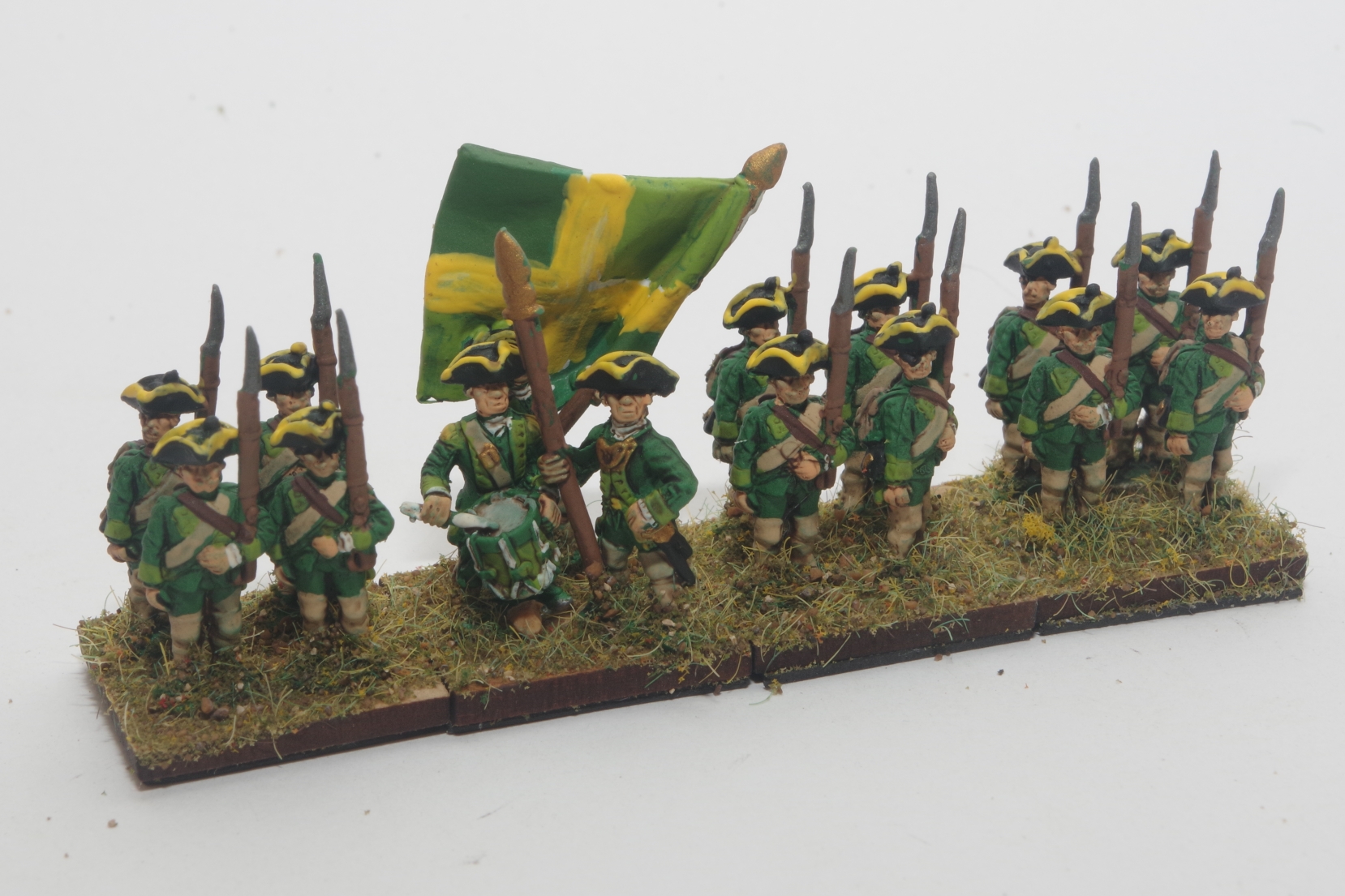
I played this game of
Sharp Practice at
the club last Sunday against Martin. This was an 18th century imagi-nations game, involving, as usual, my 15mm Syldavian and Bordurian armies of
Essex Miniatures. The scenario was a modified version of the Escort Duty one in the SP rule book.
A Syldavian column is escorting a supply train through light woods towards the town of Turksi Bazar, a few miles west of the River Drinje which is the border between the two countries. The town is being blockaded by a Bordurian force.
To win, The Syldavians must move the convoy they are escorting into the town. The Bordurians must capture the convoy.
Turksi Bazar is surrounded by a ditch and has small bastions and a low and largely ineffective wall around the town. To the south of the bridge into the town are fields and a walled market garden.
Turksi Bazar is garrisoned by a small Syldavian force, which consists of;
4 x groups of 8 x Fusiliers, Status III leader Status I leader
1 x cannon with 5 x crew and Status I leader
The supply convoy is accompanied by;
2 x groups of 8 x Pandurs Status II leader Status I leader
2 x groups of 8 x Fusiliers *Status II leader Status I leader
1 x groups of 6 x Pandur Skirmishers Status I leader
1 x group of 8 x Hussars Status II leader + 1 Musician
1 x group of 8 x Dragoons Status II leader
The Syldavians are accompanied by a British military agent,
Captain William Huntley-Palmer. He is only activated when the blank chip is drawn. He is classed as a Status III leader and can be used to replace any leader who is killed or knocked down. He may also remove shock from any unit to which he is attached. He is otherwise treated as a Minor Character.
The convoy will move whenever the *leader of the convoy's chip is drawn.
The Bordurian forces have been hampered by a lack of artillery and will only be able to capture the town if they can starve out the defenders.
The Bordurian force is;
3 x groups of 8 x Fusiliers Status III leader Status I leader
3 x groups of 8 x Freikorps Status II leader Status I leader
2 x groups of 8 x Haiduk Status II leader Status I leader
1 x group of 6 x Hajduk Skirmishers Status I leader
1 x group of 8 x Hussars Status II leader
1 x group of 8 x Lancers Status II leader
1 x group of 8 x Dragoons Status II leader
Part of this action report is taken from dispatches sent by Captain Huntley-Palmer to his relative and patron, General Sir George Augustus Melchett, known as "M" in all documents.
"I travelled with the convoy heading towards the town and trading entrepot of Turksi Bazar in the company of of an agreeable acquaintance, Hauptmann Riccardo Zamponi, an Italian gentlemen serving in the Syldavian Infantry. I was pleased to see that our small company also contained a contingent from the Douma Regiment of Pandours, stout fellows whom I had cause to thank for saving my health on more than one occasion previously.
We were making slow progress through the forests towards the town because we were aware that there were many picquets of Bordurian Horse in the vicinity."
"Before long, we encountered a defensive line of white-coated Freikorps infantry, supported by Huzzars and those devilish Bordurian Lancers who were known as Ulani in the tongue of the Borduri. While Hauptmann Zamponi halted his column and deployed his Fusiliers and Pandours into line, the troop of De Bourbon Dragoons took little time before charging the Lancers who were emerging from the scrubby forest."
"As the sound of musketry crashed across the clearing, the Dragoons, dressed in the French manner to honour their patron and honorary colonel, Queen Octavie de Bourbon, the wife of KIng Ottokar, charged at the Gallop into the Lancers, putting them to the sword and forcing them to flee the field in disarray. Although the gallant Syldavian Dragoons had triumphed, their numbers were somewhat depleted and soon came under fire from Bordurian Hajduk skirmishers in the trees."
"On our right flank, the Light Bobs from the Douma Pandours had inflicted several casualties on the blue-coated Bordurian Huzzars, who I believe belonged to the feared Schtroumpf regiment."
"After the battle, I discovered that the commandant of the Syldavian garrison in Turksi Bazar had been roused by the sound of musketry and led his troops towards the fray. It was his intervention that helped take the pressure off of our gallant soldiery. His Fusiliers were soon engaged in a duel of musketry with their Bordurian counterparts, with both lines receiving casualties, although neither side were shaken."

"One of the garrison's small number of cannon was deployed into a corner bastion, where it was able to command a clear line of fire across the open ground that separated the town from the woods. I discovered in the aftermath of the fighting that this gun had fired Cannister into the flank of a troop of Bordurian Dragoons who had been sent to strengthen the line of green-coated Fusiliers who were threatening the Syldavian garrison. The Shock of the unexpected blast of Cannister had caused many casualties and despair and fear in these Dragoons, who were sent reeling away from the source of their woes, crashing through the Freikorps line, and also disordering the line of Hajduks beyond them. In a stroke, the Bordurian invaders were so discomfited as to be incapable of further preventing our gallant relief force from reaching the beleaguered town. The morale of the Autokrat's raiding force was shaken to the point of collapse. The coup-de-grace came when the fresh riders of the Vranach Huzzars charged across the open ground, outflanking the Hajduk skirmishers and plunged into the fleeing Freikorps infantrymen, inflicting such a Huge Shock that the morale of the Borduri fell so low that they had no alternative but to flee the field in ignominy and disarray."


Well, that could have been a very different battle if it wasn't for that single blast of canister. In Sharp Practice, canister inflicts double the normal amount of shock, which was doubled again because the Dragoons on the receiving end were hit in the flank. They then broke because they had more than twice the amount of shock as they had figures, and went 2D6+6" directly away from the cannon. That took them through two formations of infantry, which had already acquired a fair amount of both casualties and shock and were then bequeathed 9 extra points of shock each from the broken cavalry. Ouch! At that point, the Bordurian infantry were not only forced to withdraw, but one formation had so much shock that it was also broken and fled. The Bordurian Force Morale plummeted.
After a couple more rounds of play, further events led to more setbacks for the Bordurians and their FM was soon at Zero.


.jpg)