Showing posts with label imagi-nations. Show all posts

Saturday, 17 January 2026

Back to the 18th century and a return to my imagi-nations

It is quite a long time since I painted any troops for Syldavia and Borduria, but I've been painting Grenadiers. First, two groups of grenadiers for the Freikorps Schtroumpf;


A couple of groups of grenadiers had been in my plans for a very long time, a decade in fact, but I'd not done anything about them until now. I'd always planned for them to have the white and blue Schtroumpf uniform colours, but with red facings. The figures are from Essex Miniatures and are actually Prussian Von Schony grenadiers. I've added in an officer, NCO and Drummer. The drummer in the front group is there for colour, but is treated as a man with a musket for Sharp Practice purposes.

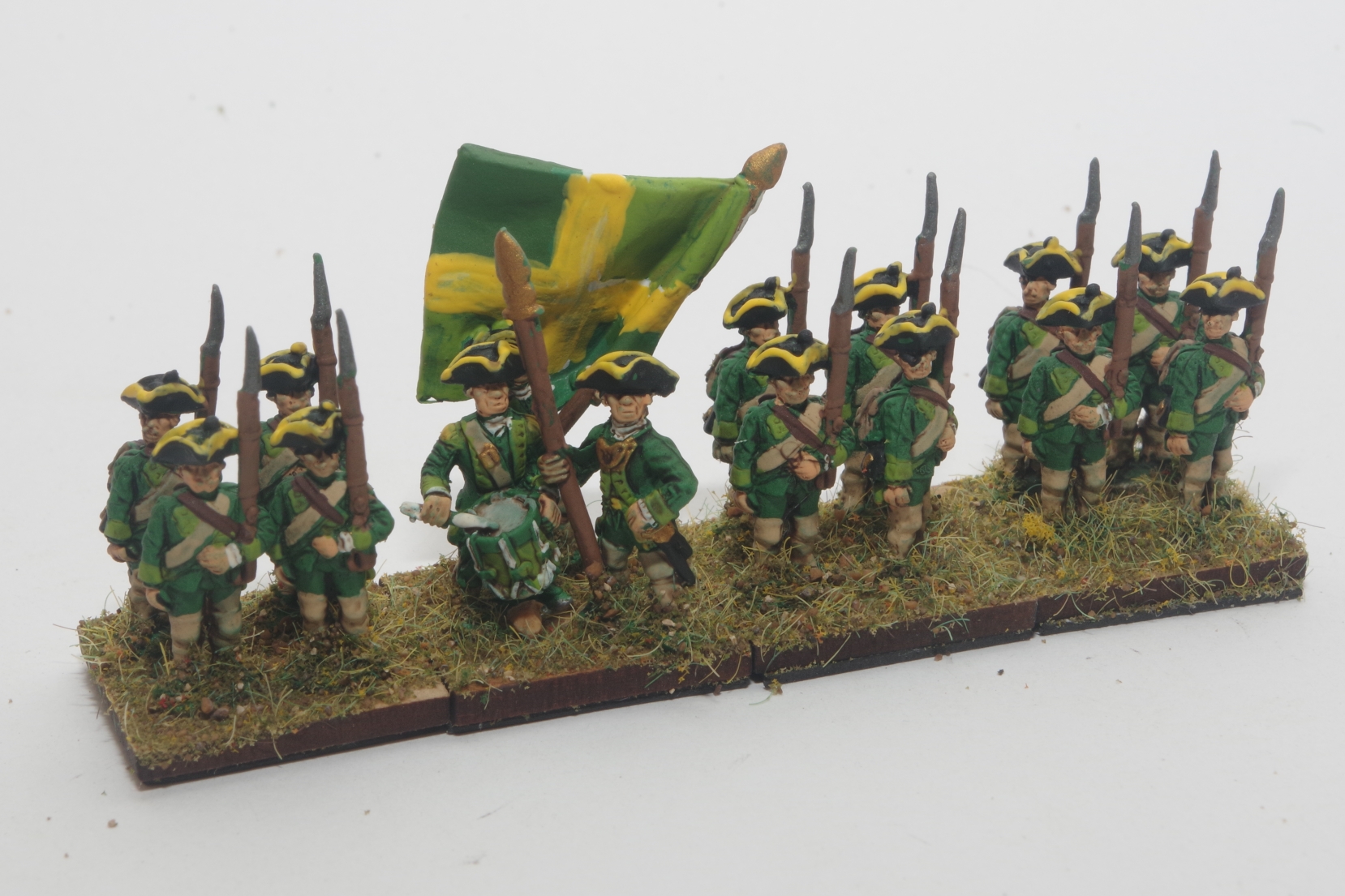
Next are two groups of Syldavian grenadiers, once again from Essex Miniatures' SYW Austrian range;

As I already have one group of 8 grenadiers from the Istow Regiment, I decided to paint two groups from other regiments, so I could have a Combined Grenadier formation for Sharp Practice. The front group  with green facings is from the Lippzshutt regiment and the group behind with black facings is from the Motörkopf regiment. Again, I have added a couple of officers, a drummer, an NCO and an ensign with a standard, showing the famous Black Pelican of Syldavia.

These chaps will be getting their tabletop debuts at Winter Wonderlard VI at BIG in Bristol on SAturday 7th February.

Sunday, 30 October 2022

Dragoons and Hussars for my 15mm SYW project

Here are the last of my cavalry for my Honours of War 15mm imagi-nation, The Grand Duchy of Überwald.

First, a brigade of Dragoons, with their brigadier;


I decided that the Dragoons, because of their roots as mounted infantry would wear the standard grey coats of Überwald infantry regiments but with orange facings. The Dragoon regiments would be distinguished by different coloured breeches and the trim on their horse blankets. Here, I have given one unit yellow breeches and the other has light blue ones.

Obviously, by the time of the SYW these dragoons would be classed as medium cavalry, rather than having a dismounted role.

My last set of cavalry are the Hussars;


I've given both regiments green dolmans and pelisses, but different coloured breeches, boots, fur trim and busby bags (which match their breeches). I decided that all Hussars in the Überwald army would have red shabraques edged in white, but I'm not really planning to paint any more regiments of Hussars, mainly because they aren't really dealt with properly in the Honours of War rules. The rules make it clear that if you want useful cavalry they have to be heavy ones, which is a shame. Hussar uniforms are always so striking.

I had a couple of spare figures left over, so I decided to rebase two of my brigadier figures to add an extra figure on each base;


I think that this looks a lot better than just having one figure and I might have to look around for a few spares to improve my remaining brigadier bases.

Anyway, I've now finished off everything I bought up front for this army. If I want to add anything different, I'll have to spend more money with Essex Miniatures.  I do quite like the idea of a Freikorps brigade, maybe a couple of battalions of line infantry and one of skirmishers, perhaps with a squadron of cavalry of some kind. I'd also like to do some allied heavy cavalry, based upon the Essex SYW British Horse Grenadiers. There is no rush, though.


Wednesday, 19 October 2022

Three units of heavy cavalry for my SYW imaginations project

So, it is time for the cavalry part of my Uberwald SYW army. First, three units of big men on big horses, i.e cuirassiers, the armoured fist of the mounted arm.

These are the Garde zu Pferde, resplendent in their blue uniforms, led by their Brigadier and a trumpeter.


Next are two squadrons of line Cuirassiers, wearing buff uniforms.


These units could all be brigaded together or I might use them as shock troops to be supported by Dragoons and Hussars.

Thursday, 8 September 2022

My last three SYW infantry battalions

I've finally nearly everything done for my Honours of War project, apart from the cavalry. Here are my last three infantry battalions;


Overall, I am pretty happy with what I've done with this army so far. Even without cavalry it is a pretty reasonable force. It would certainly suffice for most games of Honours of War.

I'll be working on the cavalry over the rest of September and into October, but for the moment I will be concentrating on a 28mm Austrian Napoleonic project that I really should have got on with last year. 

Tuesday, 6 September 2022

Allied infantry battalions for my 15mm SYW project

The Grand Duchy of Überwald's army usually includes allied units.


These two battalions represent troops recruited in the Margravate of Streslau. The current Grand Duke, Carl Emanuel III was the Margrave of Streslau before succeeding his father, Carl Emanuel II to the title several years ago. Streslau has been a feudal vassal of Überwald since the 16th century and provides well-respected and stubborn infantry to the Ducal Army.

The infantry regiments of Streslau wear green uniforms and their standards are distinguished by the yellow Cross of St Alberich, the patron saint of Streslau.

Saturday, 3 September 2022

Guns and limbers for my SYW project

Here is the artillery for my SYW imagi-nation for Honours of War;


Above we have the limbered guns for movement before or after deployment and below I have placed a cannon on one of the artillery bases I finished a while ago, to show how the deployed guns will appear on the table. I think this has come out rather well.

I have also finished off the rest of my infantry battalions, but I will do a separate post about these.


Tuesday, 23 August 2022

Lots more recruits for my 15mm SYW forces

Apart from when it has been too hot to paint, I have been continuing my Honours of War project. First, two battalions of line musketeers and a brigadier;

Next a battalion of the Grand Duke's Garde zu Fuß and the army commander;

Note that these guys have blue uniforms. It is annoying that the general and his ADC are a bit blurred but I can't be bothered to retake the photo.

Thirdly, here are the rest of my brigadiers, probably more than I'll ever need in most games;


Note that I've done a couple in green coats. This is because I want to have the possibility of grouping all the Freikorps light infantry into a single brigade and also because I have decided that senior officers in the army of the Grand Duchy of Überwald should have considerable freedom in what they can wear on the battlefield.

My last picture shows four bases of artillerymen;


These are awaiting their guns, which I intend to be freestanding so that I can attach them to limbers until they are deployed. I have decided that the Überwald should also wear a similar blue uniform to that of the Ducal Guards because the Großherzog is a great believer in the importance of artillery.

I am currently working on the remaining five foot battalions and then I will start on the guns and limbers for the artillery. That will leave me with the cavalry units and then, perhaps, the army will be complete. Maybe not, though, because I would like to create a separate Freikorps containing line troops, skirmishers, artillery and some cavalry, so that I could field them in certain scenarios. It wouldn't be a massive force, maybe two or three battalions of line, one of skirmishers, one artillery battery and a single unit of dragoons.


Tuesday, 9 August 2022

A new project - SYW 15mm troops

This project is something I had no idea I was going to do at the beginning of the year, but a few people at the club were getting interested in the Honours Of War rules from Osprey and were using SYW armies that they either already had or were putting together. I played a couple of games and, although I have some reservations about the rules, I decided that they weren't too bad and I ought to put an army together too.


The rules allow for the use of imagi-nations, which is something that I am very much in favour of because it takes me back to Charles Grant and his wars between the Vereinigte Freie Städte and the Grand Duchy of Lorraine in his classic book, The War Game.

My project is to create the army (in our chosen scale of 15mm) of the Grand Duchy of Überwald (a name that will be familiar to Terry Pratchett fans), a long vanished entity from somewhere near Austria. 

The rules in the book uses infantry battalions made up of five elements, but because some players have battalions of four elements, we have agreed on this for our campaign, which is supposed to begin in the autumn. We are also reducing cavalry squadrons by one element too, to keep frontages in proportion. 

Our campaign will be using a blend of real and imaginary states, so long as the imaginary armies have the characteristics of the real ones in the book.

The Grand Duchy of Überwald's army will be using Essex Prussian minis and will be based on the rule book stats for Austria.  As you can see, their flags will look rather French too.

So far, I have completed two battalions of Grenadiers and three of light troops, as pictured above. My plan is to have ten battalions of infantry, three of light troops (most likely a Freikorps) and seven squadrons of cavalry of various types, plus medium artillery and a number of brigadiers and an army commander. I expect that my imagination will run away with me and I end up with a few more units.

To provide a nice colourful appearance I will paint up some infantry in colours other than grey. There will be a battalion of Garde zu Fuß musketeers in blue and two more battalions in green, representing troops from the Margravate of Streslau, a feudal vassal of Überwald. There will also be artillerymen, cuirassiers (including one of Garde zu Pferde), dragoons and hussars in a variety of uniforms.

I am going to have to work quickly. I also have a 28mm Austrian Napoleonic project that I need to finish by November. So far, everything is assembled, based up and undercoated.

Thursday, 8 October 2020

A bit of background on Orangenland, my 17th century imagi-nation.

In a previous post, I introduced Orangenland, a minor North German state of the 17th century. In this post, I will be describing the place in a bit more detail.

The origins of Orangenland lie in the early mediaeval Kingdom of Lotharingia, created out of the protracted period following the end of Charlemagne's Frankish Empire. Little is known about the early histories of the three component territories of Orangenstadt, Orangenwald and Orangenburg, although it is clear that the origins of Orangenstadt lie in the building of the Abbey of Saint Octavius the Martyr in the 12th century and the development of the town that grew up around the abbey. This town, originally known as Octadorf, grew in importance until it was recognised as the seat of the Prince-Bishop of Sankt Octavius in 1312. When the House of Chalon-Arnay acquired the three territories through marriage, they were known as Bisschoppenstadt, Osterwald and Nordburg. They were renamed following the acquisition of the Principality of Orange by the House of Chalon-Arnay. Bisschoppenstadt was renamed as Orangenstadt in 1473 when it was rebuilt following a disastrous fire in 1469 that destroyed much of the older city.

The population of Orangenland is split between Limburgish and Brabantian Dutch speakers in the east, speakers of the Rhenish Franconian dialect of German in the west and some Picard French speakers in the south.

The seat of the House of Orangen is the city of Orangenstadt, which is dominated by the late mediaeval Chalonerschloss and the Cathedral of Sankt Octav, which was rebuilt on the ruins of the earlier Abbey, destroyed in the Great Fire of 1469.

Other prominent towns and cities are Nordenstadt, Catieau-Arnay, Wijndorp, Druckerburg and Salzfischstadt.

The flag of Orangenland is a golden Lion Rampant bearing a sword, on a field of red, although a standard showing a red cross on a yellow field is also carried by some troops.

The House of Orangen has long maintained friendly relations with a number of other small dukedoms and counties in the region, most prominently the County of Pirlouit, whose ruling family, the House of Schtroumpf is related to the House of Orangen by marriage. Indeed, one member of the Schtroumpf family, Armin von Schtroumpf currently serves in the Orangenland army. Although he is young and a relatively junior officer, he has gained a reputation of being a brave, if occasionally hot-headed leader, who is loved by his troops, many of whom were recruited in his homeland. Troops under his command usually wear a blue sash and occasionally blue and white plumes on their hats and helmets, these being the colours of the House of Schtroumpf.

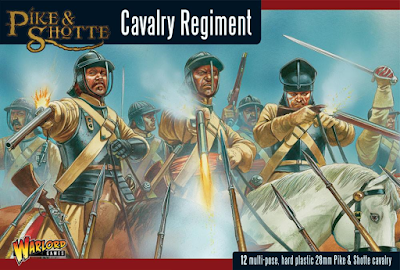
In other news, I have acquired enough figures now to create a variety of units for my Orangenland army for The Pikeman's Lament. These are all from Warlord Games and consist of;


From these boxes I will be able to build one unit of 12 Pikemen, two units of 12 Musketeers, a unit of six Gallopers, a unit of six Trotters and two elite units of Gallopers and Trotters in cuirassier three-quarter armour. I will also be able to build units representing a Forlorn Hope and Commanded Shot, so there will be plenty of variations for the troops that Armin von Schtroumpf will be able to call upon in his battles.

There will probably be a few spare figures that I can use for other things that I currently haven't even thought about, although I am definitely planning to do Armin von Schtroumpf in both mounted and foot versions.

Tuesday, 22 September 2020

Orangenland - a 17th century imagi-nation

 A couple of years ago, I received The Pikeman's Lament rules as a Christmas present. I liked the idea of using the rules for a Thirty Years' War project, originally planning to use the really nice Peter Pig ECW 15mm figures, with multiple figures on bases to make each unit look bigger, but I later thought about doing it in 28mm instead. I like the look of the Warlord Pike and Shotte figures, especially the plastic boxed sets. I worked out that I could probably put a nice starter army together from a single box of infantry and one of cavalry.


Anyway, to do a project, I would need some context, a backstory for the troops. So, I invented a North-western German state, the Duchy of Orangenland.

Orangenland is made up of three separate territories which were once feudal possessions of the House of Chalon-Arnay, which acquired the title to the Principality of Orange in the late 14th century. Sometime after 1500, the lands passed into the hands of an illegitimate son of the House of Chalon-Arnay. This son, Philibert of Orangenstadt, became a soldier of fortune in the armies of Emperor Charles V, who ennobled him as Herzog von Orangen, uniting the three Kreise of Orangenstadt, Orangenwald and Orangenburg into the Duchy of Orangenland.

Although Philibert was a Catholic, his son  Karl Adolph adopted the Lutheran religion in the 1540s, and the Duchy adopted Lutheranism following the 1555 Peace of Augsburg. Herzog Karl I died in 1584, leaving his son Karl Christoph as Herzog.

Orangenland remained a minor North German state, known mainly for brewing and pork products. Orangen Weissbier was and still is famous as far away as Ruritania The local wine made from the Elbling grape variety is, occasionally, drinkable.

The wine of Orangenland is the main reason why the ruling House of Orangen was an early investor in distilling. Orangenweinbrand is a much more popular drink than most of the wine produced in the Duchy, and is even exported to places as far away as Syldavia and the Duchy of Strackenz.

So, in 1618 on the eve of the terrible Thirty Years' War. Orangenland was a peaceful backwater, but Karl Christoph, Herzog von Orangen had grand expansionist designs and aspired to military glory. Unfortunately, his ambitions were greater than his Treasury permitted and he soon became heavily in debt and became unable to pay off his mercenary general, Willem van Metwoorst, who refused to leave the Duchy with his army unless the money he was owed was forthcoming. Karl Christoph's unscrupulous younger brother Georg Wilhelm had long harboured designs to replace his brother, and to that end began negotiations with several banking houses so that he could borrow enough money to buy the loyalty of Captain van Metwoorst for himself, and then arrange an accident for Karl.

Following the unfortunate hunting accident, Herzog Georg Wilhelm gained an alliance with the United Provinces, claiming an almost completely non-existent but artfully constructed familial relationship between the House of Orange-Nassau and the House of Orangen. This helped smooth the path between the Orangenland Treasury and the banking houses of Antwerp and Amsterdam.

Willem van Metwoorst, was granted the title of Captain General of Orangenland and the army became organised along Dutch lines. From the late 1620s onwards, the Swedish King, Gustavus sent military aides to the Duchy and Scottish recruits began to swell the ranks of the army. A stout defender of the Protestant religion, Georg Wilhelm deftly managed to steer a path between his somewhat dissolute and murky private life and the sterner demands of his professed faith.

So, there is the introduction to Orangenland, its ambitious Herzog and his hard-bitten Captain General Willem van Metwoorst. I shall return to the Duchy again in the future.


Tuesday, 18 August 2020

Another group of auxilia

I did a group without javelins, for variation, and I added in a couple of figures from the command sprue, based on the Cornicen and Signifer bodies.


I used the Imaginifer arm from the auxiliary cavalry set, because I thought it would make a nice variation to have an Imago for my cohort. I also gave the other body from the command sprue a gladius and a small parma shield (this is actually because I am running out of oval shields).

I have enough bodies left to make up another group and also another deployment point vignette. I shall have to stick these together and get them underoated.

Saturday, 1 August 2020

Auxiliary archers

Another rush job! I need these for Sunday and only had them undercoated this morning.


These are from Aventine Miniatures, a company that I haven't bought anything from until now, but who are definitely on my radar now. The best thing about these figures is that they scale up well against the Victrix plastics that form the rest of my cohors equitata. They are also really nice sculpts and clean castings too. They were a joy to paint.


There is a decent amount of variation in the figures, some are in mail and others in scale armour and there are little details that make them all look a bit different from the next one along.

Tuesday, 28 July 2020

Six more auxiliary cavalry

Well, I finished off my second group of six equites for my cohors equitata, and the rain held off long enough for me to varnish them. My DIY augury (would I see sparrows or magpies first if I looked out of the kitchen window?) worked for me. I shall continue to put out food for the sparrows.


I don't really need a tubicen but seeing as arms with a tuba (the Latin word for a trumpet) are included on the Victrix sprues, it seemed a shame to just ignore them. Similarly, I used an optio head for one of the equites, just for variety. I don't need an optio equitum either, but he looks nice in the group.


For a bit more variety, I have chosen a sword arm for one of these equites, and you will note that the middle one of these is wearing scale armour rather than mail. This is because each sprue in the set has one body in scale lorica, so it has to be used for ordinary troopers as well as leaders to make the most of the available models.

I have also chosen to give this group blue neckerchiefs, for variety. The first group I did have red ones. 

I have seven more horses and riders left (because I bought an extra pair of sprues on ebay to give me 20 equites in total), so I'll get them made up at some point, but I have no urgent need for them. When they are done, I'll have a second leader and one more group of six equites.

Sunday, 26 July 2020

Auxiliary cavalry

Wow, this was a rush job! I was worried that they wouldn't be finished ready for this afternoon. I couldn't varnish them until this morning because of rain and humidity.

First, we have a group of three Equites and a Decurio, the commander of a turma, that is to say, a group of 30 cavalry.


Here are the remaining three men in my group of six, as required for Infamy, Infamy, including a vexillarius. The standard isn't necessary for the rules, but it makes the unit stand out nicely.


These are intended as the cavalry component of my cohors equitata, the Cohors Primus Syldaviorum Equitata Luperci.

You will notice that their shields don't match those of the cohort's pedites, and that is because LBMS don't make the same design for the slightly smaller Victrix Roman cavalry shields. I suppose I could have cut the edges a bit smaller on some infantry shields, but I decided that the equites of the cohort were distinguished by a separate shield design. In actual fact, we don't know whether all members of a cohort would have carried identical shields anyway. It seems a reasonable assumption, but in the absence of any firm evidence, I think it gives us the opportunity to do what we see fit.

So, for the Cohors Primus Syldaviorum Equitata Luperci, I have decided that the turmae of equites would carry a separate design, which I shall justify by reference to the entirely invented Annales Syldaviorum of the little-known 2nd century writer Lucius Porcus Crustum, himself of Goganian origins, who lived in Istriodunum during the reign of Marcus Aurelius. 

In Book XIV of the Annales, he writes that "the turmae of the cohort of the Brothers of the Wolf were distinguished by their red shields which were decorated with entwined vines in flower, honouring the god Bacchus, Father of the Vines, known as Dionysos Eleutherios by the Greeks and Illyrians".

So, there we have it. Who could possibly disagree with L. Porcus Crustum?

Anyway, I have more cavalry to finish, which I will work on in groups of six, and eventually there will be two more groups and another separate character figure.

Thursday, 23 July 2020

The last group of auxiliary infantry (for the moment)

The last group? Well, yes, because I need to get on with the cavalry for my cohors equitata.

Here they are, pretty much looking the same as their comrades I've already posted;


I don't really have anything new to say about them, because everything has already been said.

I am currently working on some auxiliary cavalry, once again Victrix plastic ones, and I need to get at least one group of six plus their Decurio finished before Sunday, because the Lincombe Barn Wargames Society is back in action and I have a game planned for the 26th. I want some hooves on the table as well as caligae.

Tuesday, 21 July 2020

Eight more auxiliaries

The strength of the Cohors Primus Syldaviorum Equitata Luperci grows as eight more recruits are mustered before their Praefectus.


As you can see, I am now able to put these on their movement sabots from Warbases. I decided to do all of these carrying their javelins, mainly because it means I don't have to take a scalpel to their scabbards!

Once again, these are all Victrix plastic auxilia and the shield transfers are made by LBMS, and can be purchased from the Victrix website too. 

I now only have  one more group of eight auxiliaries to finish off and then I can start on my cavalry, who are all primed ready for painting.


Monday, 20 July 2020

Three more characters for my auxiliaries

These were a bit of an experiment, but I think they have worked OK.


Of course, when I say experiment, I mean a bit of very minor kitbashing. From left to right, they are a Capsarius, a sort of battlefield medic, an officer of some kind and another Optio, this one doing some kind of twirling thing with his staff.

The officer type and the Optio were made using two unwanted bodies from the command sprue in the Victrix EIR Auxilia set, and I rather like them because they are wearing the kind of lorica hamata with reinforced shoulders that we might associate more with legionary troops rather than auxiliaries. 

Because the figures are supposed to be a signifer and a cornicen, ordinary arms have to be selected carefully, hence the odd way the Optio is holding his staff.

I am thinking that the officer in the nice green cloak might come in handy as a tribunus angusticlavius, a junior military tribune from the Equestrian Order, who would make a nice Tribunus in the Infamy, Infamy campaign rules. I am sure that he will be a welcome addition to the Cohors Primus Syldaviorum Equitata Luperci. Anyway, he already has a name. He is Antonius Crispus Cerialis, from a prominent equestrian family with large estates to the west of Colonia Klovinus. The family is known for their wealth, their staunch support for Rome (whoever happens to be emperor) and their family motto, MAGNIS SUNT. The family has grown in wealth and social standing ever since the then paterfamilias Grabus Ientaculum Cerialis, a client of the gens Julia, was granted equestrian status for his support for Octavian in his wars against Mark Antony.

The Capsarius is a standard auxiliary figure with the addition of a pack from a Warlord Late War German Heer sprue that I trimmed a bit to remove most of the detail, adding a strap made from thin plastic card. I kept the water canteen, but trimmed off most of the detail to make it look like a pottery flask.

I have also received my movement sabots, so my next sets of figures will be based up ready for use.

Friday, 17 July 2020

More auxila leave the painting table

Well, they left the varnish spray booth (a large cardboard box with one side side removed) actually.


I really like these Victrix figures a lot. They have lots of detail, are fairly simply to assemble and the finished items paint up nicely, and it is easy to cut the tops off the scabbards on the figures holding gladii.

I have a couple more groups that I am working on at the moment, plus a couple more individual figures and I have also glued all my horses together, ready for undercoating. I will undercoat the riders separately, as soon as I have assembled them. I have enough mounted models to make up two groups of six, plus a decurio, which leaves me with three spares. To stop them going to waste, I have bought sprues of four more riders and horses from ebay, which will give me enough mounted auxiliaries for three groups plus two leaders. That will be a lot for Infamy, Infamy, but why not? There could be a scenario in future where I might need three groups of riders.

I've also got more infantry figures to assemble, including the spare command sprue figures. I don't need more signiferi etc, so I will experiment with these, to see if I can use the bodies to make up extra auxiliaries with different pattern lorica hamata (i.e mail shirts). The models with the muscle cuirasses will probably be surplus to requirements, but I will find a use for them somewhere.

Tuesday, 14 July 2020

More recruits for the cohors equitata

As it has stayed relatively dry, I have finished basing and varnished another group of auxiliaries.


As I wrote earlierthe (imaginary) Cohors Primus Syldaviorum Equitata had the additional cognomen Luperci ( i.e. the “Brothers of the Wolf”) because the Goganii were associated with a cult that venerated a wolf deity sometimes identified as Lykas, and this was reflected in the occasional wearing of wolf pelts as cloaks by some of the troops (actually a nice excuse to give a few of my Victrix minis the wolf pelts on  the sprues).

I have given these the shield arms with the short throwing javelins, because I like the way this looks, and I have all of these guys posed with their main javelins ready to throw. I can use these as skirmishers with Flexible Drill, and I can also mix in the slingers which I have already finished to create two groups with mixed weaponry, as shown below;


I think that this looks quite effective as a group too, but I'll be interested to hear what others think.

Sunday, 12 July 2020

Auxilia with slings

Now, in the Infamy, Infamy rules, the only slingers that are listed for the Early Imperial Romans are "Tribal Slingers", but because some of us were discussing Roman slingers on the Infamy Facebook page, I cobbled a group of eight together. I used arms with swords from my Victrix Auxilia sprues, cut the hands off and glued on slinger hands from the Gripping Beast "Dark Age Warriors" set, and here they are;


I think that slingers can be justified because the rules state that Roman Auxilia are equipped with Mixed Weapons, which are described as "The weapons of most Foot and Mounted Warriors and include swords, spears and javelins". I am thinking that "include" doesn't preclude the use of other weapons here. However, the rules also talk about Skirmish Troops, saying "These are named depending on the troop type and include slings, bows and javelins. This is their primary weapon". Now, I don't want to have any of my auxilia as "Skirmishing Troops", because that fundamentally goes against how the auxiliary cohorts operated. I just want an opportunity to give some of them the ability to use slings rather than javelins as ranged weapons, taking advantage of their Flexible Drill characteristic.

Of course, the next question is how can these guys be accommodated within the rules? Well one suggestion (made by David Hunter) is to define them as;

Auxilia with slings          Warriors                8 men. 
Medium Armour             Mixed Weapons    Slings
Aggressive Attack 2       Step Out 1             Drilled, Supra Numerum, Flexible Drill

and field them with the following proviso; 

They may only use slings when skirmishing and only half the men fire, because  loading their slings is hampered by the shields they carry.

That seems reasonable to me, but the alternative might just be to mix them in with a group of auxiliaries with javelins and ignore the fact that they have slings. Personally, I prefer the first idea, but I suppose that it is up to my opponents if they are happy to play against auxiliary slingers.