Friday, 11 October 2019

Graveyard goings-on!

Back in May, I painted up a nice Grim Reaper model. You can see it at the bottom of this post. At the same time, I also undercoated a few other resin graveyard pieces, and then stuck them away in a drawer to be completed at a later date.

Well, as you can see, they are now done. Better late than never, I say!


Like the Grim Reaper statue, these are also from Wargames Terrain Workshop, and very nice they are too.

I decided that the Gargoyles really had to have piercing red eyes, after all, they might not just be statues. There could be a bit more to them. Mwahahahahahahahahah!

Monday, 7 October 2019

The encounter at the ford - 18th century imagi-nations Sharp Practice

This is a Sharp Practice game played out at the club yesterday between myself commanding the Syldavians and Martin taking the role of the Bordurian commander, using my 15mm Essex armies. 

I have decided to write this up as an excerpt from the memoirs of Captain (later Sir) William Huntley-Palmer of the 11th Dragoons, as recorded in the Melchett Archives of General Sir George Augustus Melchett (a.k.a. "M"), a relative and patron of Capt. Huntley-Palmer.

"In the Summer of 1754, while on my travels in Syldavia representing the government of His Britannic Majesty King George II, I spent several weeks in the province of Moltuja, in the valley of the River Moltus, upstream from the town of Birna. This fertile region was often raided by Bordurian forces coming into Syldavia via the mountain pass just south of the headwaters of the Mecava Potak Reka. I was travelling with my host in Birna, the Edler Franz von Felstad and my servant Domenico, and we took the opportunity to join a small Syldavian force sent to secure a ford across the Moltus."

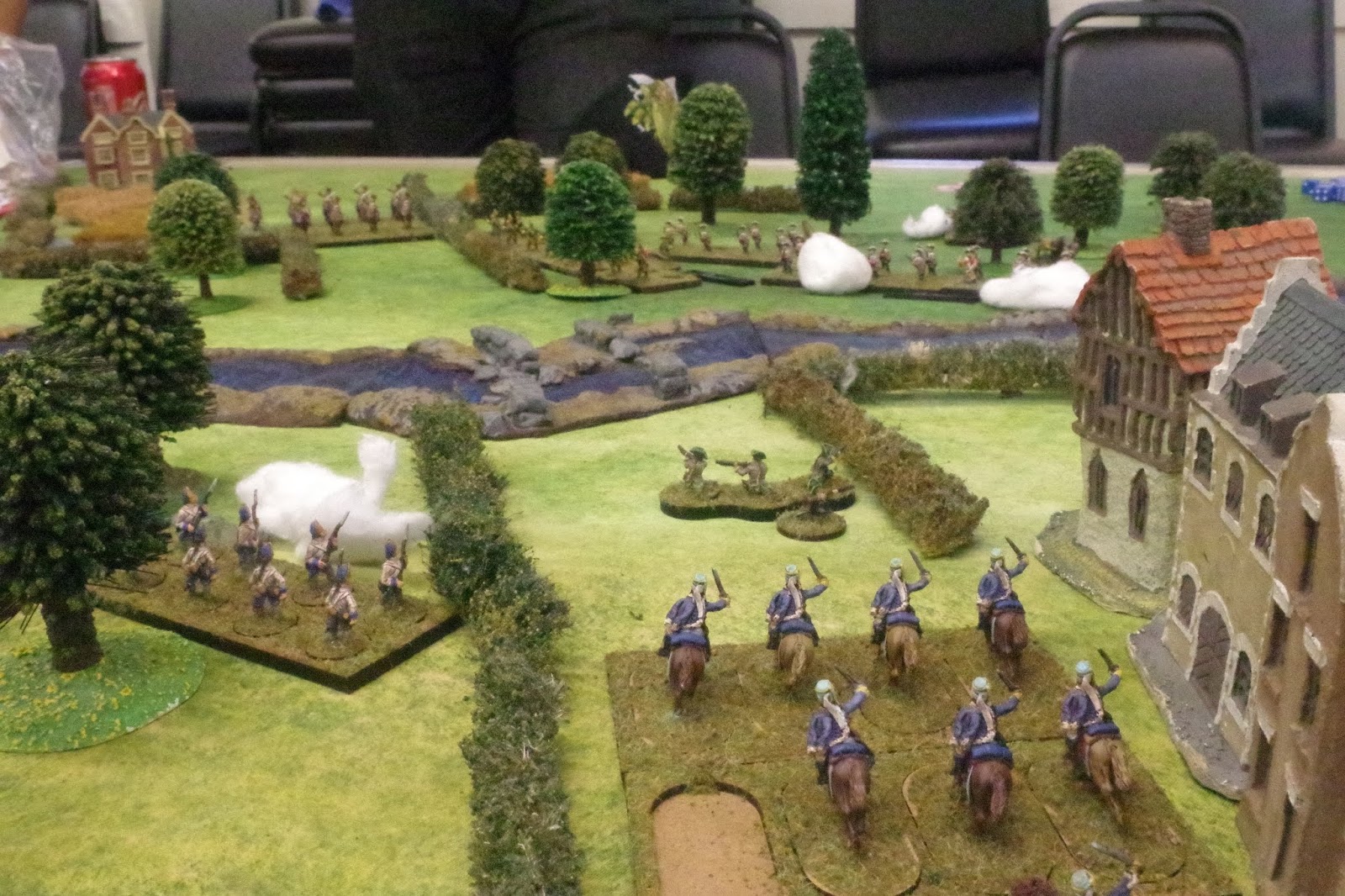
I set out the table to represent the river in an area with corn fields, trees and a small village where the ford, actually the site of a long-collapsed mediaeval bridge crossed the river. Both sets of troops consisted of five groups of line troops, one of skirmishing light infantry and one of scouting cavalry.

"The Edler von Felstad suggested that we should view the encounter from the summit of a hill to the west of the village, where we would have an excellent view of the proceedings. Von Felstad had personal reasons for watching the proceedings as his son, a Fähnrich, that is Ensign of Horse in the Vranac Huzzars was commanding the Syldavian cavalry. In addition, the Hauptmann or Captain commanding the company of Fusiliers, a Venetian emigré called Marcello Loredan was a neighbour of the Edler. We watched as the Syldavians began to advance upon the village, which was known as Koruna Kmetija in the local language. The first troops to advance were Jägers from the Strelec Regiment. In the distance we could also see white-coated Bordurians advancing. Von Felstad informed me that white coats were worn by the various Freikorps in the service of the Autokrat Constantine of Borduria, all of whom were known for their lack of moral probity and aggressive and plundering ways."


"Before long, the small company of Fusiliers from the famous Istow Regiment  began to advance, led by Hauptmann Loredan."


"As the battle unfolded, it became obvious that the Bordurians had seized the initiative, with their cavalry in position to charge any Syldavians who thought to cross the ford, which was also within the range of the muskets of the Freikorps and a company of Bordurian Jägers, whose skirmishers were equipped with rifles."


"Accurate musketry from across the river began to take its toll on the unfortunate green-coated Jägers, whose ranks were thinned as the balls hit home."


"However, the balance of power began to shift as Hauptman Loredan's fusiliers began to fire increasingly effective controlled volleys into the hated Bordurians across the river. I told the Edler that their control and accuracy was nearly as good as that of His Majesty King George's Foot Guards. Not really true, but my commission from General Melchett stressed that I should use praise and flattery wherever possible to gain the confidence of my Syldavian hosts."


"I noted with interest that the Bordurian Huzzars began to advance along the road towards the river. Surely they were not intending to cross into the hail of musketry?"


"I could only assume that their leader was a typical impulsive light cavalryman, such as those who fought with the Croats in the French service."


"I will admit that it was a stirring sight to see the Bordurian Huzzars, who I recognised as being from the well-known Freikorps Schtroumpf, gallop across the ford into contact with the Vranac Huzzars led by the young Fähnrich von Felstad. Initially pushing the grey-coated Syldavians back, the Schtroumpf Huzzars charged again, but were repulsed on the second attempt by the gallant Vranac troopers, who managed to kill the impetuous officer who had led his men to their doom. Musketry from short range from the Strelec Jägers lining the hedge took a further toll on the Freikorps riders who would take no further part in the proceedings."


"It seemed to me that the failure of the Bordurian cavalry, taken together with the weight of musket fire from the Istow Fusiliers was shifting the balance towards the gallant troops of my Syldavian hosts. Although both sides had suffered losses, the butcher's bill on the Bordurian side seemed to be rising at a faster rate. The Edler gripped my arm excitedly, says "My dear Captain Huntley-Palmer, I do believe that my son's intervention has swung the fight in our favour. I think that the Bordurians are obliged to withdraw." I murmured my agreement as I gazed across the field of honour. It did seem to me that the fusiliers of the white-coated Freikorps Schtroumpf were retreated through the woods, whence they had come only a short time ago. I offered my congratulations to the Edler and thanked him for the opportunity to see the Syldavian army in action. Privately, I thought that my next despatch to "M" would be of interest to Horse Guards, whose offices and clerks would apparently soon be housed in a new building**."


** The old Horse Guards building, which had become the administrative headquarters of the British Army was falling apart by the 1740s and a replacement building was commissioned in 1745. However, building works stretched out for about a decade after work first began in 1750.

Wednesday, 2 October 2019

Nijmegen weekend - Big CoC at BIG

Last weekend, it was time to go down to Bristol Independent Gaming for two days of 15mm Chain of Command to play out a number of scenarios in and around Nijmegen during Operation Market Garden in 1944.

Day One

The weekend was excellently organised by Jimmy, who set up three interesting tables for the first day. The first represents the Hunnerpark, with the bridge over the Waal off at the top left. SS Panzergrenadiers would be defending the approaches to the bridge along the left of the table, with 82dd Airborne coming from the right Both sides had limited armour support.


The second table represents the approaches to the railway bridge. This would be an all-armour affair, with Guards Armoured coming up against Jagdpanzer IVs.


Finally, the road north of Nijmegen with 82nd Airborne attacking from the top, with the road defended by an ad hoc Heer Zug, made up of rear echelon troops.


The fighting was fierce on all three tables, with the Allies coming out victorious in the latter two encounters, but being forced to withdraw from the fight in the Hunnerpark dues to heavy losses. In early random event caused this house to the south of the park to catch fire. This was a mixed blessing for both sides, but overall it favoured the defenders.


The Panzergrenadiers had a huge superiority in firepower, with two MG42s per section, and these really swung the result.


This PaK 40 was a threat to the 82nd.


This single Guards Armoured Sherman was a problem for a long time, but was finally knocked out by the Jagdpanzer.


Even though the 82nd were able to use the smoke to try and outflank the defenders, their numbers were too few to take the bridge without armour so the US commander decided to pull out.


The fight in the marshalling yards was a real cat-and-mouse affair, with the Allies finally gaining the upper hand, knocking out all three Jagdpanzers for the loss of one Sherman.


On the final table, the 82nd managed to push out the Heer Zug defending the road.


This final table was in the balance for a long while, but the superior abilities of the 82nd won the day in the end.

Day Two

The second day was a single huge game of Big CoC, i.e. Chain of Command with multiple players on each side. The rules can be found here, on the TooFatLardies blog. Of course, you'll still need the main rules to play this amendment.

The scenario was set in Lent, a suburb of Nijmegen north of the road bridge over the Waal. The premise was a German counter-attack from the direction of Elst, north of Nigmegen to try and recapture the Waal bridge, which even though the south end was still in German hands after Day One, the defenders had been forced to withdraw due to the Allies taking the northern end of the bridge and bringing armour up over the rail bridge.

Here is the view from the German end, looking south. the low-lying land either side of the road was boggy, meaning that armour risked bogging-down if it chose to drive across it at anything other than slow speed. The Germans needed to get infantry across the open ground to try and hold the crossroads in the centre of the village.


A good patrol phase saw the Germans get jump-off points (marked by SdKfz 251 half-tracks) in the woods to the right and also up on the edge of the table on the left.


The final German JoP was close to the road at the German end of the table.


The Germans received a lot of support points, giving the Panzergrenadiers an additional section and the Heer Zug two extra sections. They also got two PaK 40 guns and an additional Senior Leader.


Before long, the Heer Zug was in action close to the hedges, threatening one of the Allied JoPs.


The Panzergrenadiers and guns on the right stayed on Overwatch, awaiting developments ahead. The Armour, in the shape of four Jagdpanzer IVs was held in reserve off-table.


A Panzerschreck team was sent towards Lent, to try and get close to the action, but also to see if the Germans could advance a JoP. Unfortunately, it was targeted by mortar fire and killed.


The Panzergrenadiers once again used their MG42s to great effect, pinning on section of the 82nd and causing shock to another.


 On the left, the Heer Zug moved through the woods, while the section by the hedge survived a bout of hand-to-hand combat, wiping out thie opponents, and threatening an Allied JoP.


Meanwhile, the Allies in Lent were getting troops into the houses. The village was looking like a tough nut to crack, especially with the arrival of the Guards' tanks.


As the Heer Zug made ground through the woods, the detached section captured the JoP. Events were pushing Allied Morale down, but their position was too strong to take by a frontal assault. The tank Troop Firefly had a view all along the road, making it risky to bring on German vehicles.


The 82nd troops were forced out of the upper stories of the buildings, meaning that the flat ground outside the village was now dead ground.


Heavy accurate MG42 fire was causing the 82nd a lot of casualties, but what was needed was some aggressive movement. The Heer Zug was taking a lot of fire too, so the SS Panzergrenadiers began to advance through the dead ground where the Allies couldn't see them.


Finally, the Jagdpanzers began to slowly attack. This paid off handsomely, when the lead Jagdpanzer knocked out the Firefly after a short exchange of fire.


The German infantry finally got to the hedge, but were immediately fired upon from the buildings.


The Panzergrenadiers also captured another Allied JoP, causing another drop in Force Morale.


Another Sherman was brewed-up by a Panzerfaust shot. The Allies were now down to a single tank.


That last Sherman took out the leading Jagdpanzer.


The Germans managed to get infantry inside the village, but fresh 82nd sections appeared, inflicting many casualties. Although the Allied Force Morale was getting low, and they had lost a couple of Command Dice, it was difficult to see how the Germans might get them out of the buildings without taking a lot of casualties.


As we were out of time, Jimmy, who was umpiring called time. All the players agreed that although it was a minor German win, overall, the counter-attack had failed in the aim of getting the Allies out of Lent and taking back control of the crossroads.

So, all in all, an excellent weekend of gaming. Thanks to Jimmy for organising the proceedings and to Dave, Dee, Andy, Ed and John for being such good allies and opponents.